Turning Visitors into Clients with a Film and Video Production Landing Page
In the fast-paced world of visual storytelling, your portfolio is only as good as its accessibility. You might have shot an incredible commercial, directed a moving short film, or captured a wedding that made everyone cry happy tears, but if potential clients can't immediately understand what you offer or how to hire you, that work stays in the shadows. This is where a dedicated Film and Video Production Landing Page becomes essential. Unlike a sprawling website with multiple tabs and confusing navigation, a landing page is a focused, single-screen experience designed to do one thing: convert a visitor into a lead.
Think of this digital asset as your 24/7 salesperson. It doesn't just display reels; it contextualizes them. When a marketing director lands on your page after seeing your name on LinkedIn, they aren't looking for your life story or a blog about camera gear. They want to know if you can solve their specific problem, see proof that you've done it before, and find a clear button to contact you. A well-structured layout strips away the noise and highlights your capability, making the decision to hire you feel like the most logical next step.
Real-World Scenarios Where a Focused Layout Wins
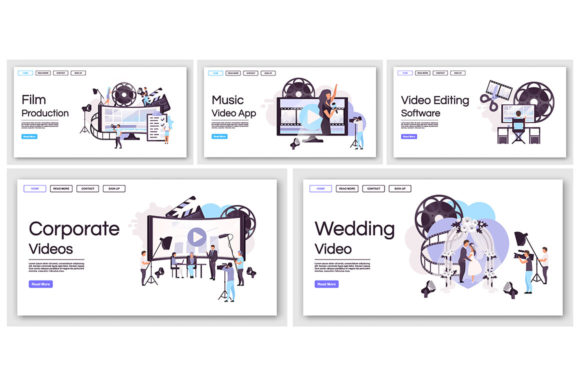
The utility of a specialized landing page extends far beyond just having a "website." Different professionals leverage these templates in unique ways depending on their immediate goals. For instance, consider a freelance videographer who specializes in event shooting. During wedding season, they might direct traffic from Instagram ads specifically to a page featuring flat illustrations of happy couples, a concise showreel of ceremony highlights, and a straightforward pricing package list. This targeted approach ensures that engaged couples don't get distracted by corporate headshot services or music video edits that aren't relevant to their needs.
On the other end of the spectrum, a boutique production house pitching to tech startups needs a different vibe. Here, the filmmaking homepage layout should exude innovation and precision. Using a web banner that features modern, clean lines and perhaps a webpage cartoon concept explaining their pre-to-post production workflow can demystify the complex process for non-creative founders. When a founder sees a visual breakdown of how you take a raw idea to a polished 4K deliverable, trust is built instantly. The landing page acts as a bridge between technical expertise and business value.
Educators and trainers also find immense value in these resources. Imagine a film school instructor creating a resource hub for students. By utilizing a template with clear sections for equipment lists, shooting schedules, and safety protocols, they provide a professional-looking interface that encourages student engagement. Similarly, bloggers and content creators who are transitioning into offering paid courses on videography can use these layouts to sell their curriculum. The key is matching the visual tone—whether it's gritty and cinematic or bright and instructional—to the specific audience you are trying to reach.
Why Visual Consistency and Vector Templates Matter
A common mistake creators make is cobbling together a site with mismatched images, low-resolution logos, and inconsistent fonts. This lack of polish subconsciously signals a lack of attention to detail in your actual video work. This is why starting with high-quality Film and video production landing page vector templates is a strategic move. Vector files, such as those in AI, EPS, or SVG formats, allow you to scale graphics without losing quality. Whether you are viewing the design on a massive cinema monitor or a small smartphone screen, the event shooting website interface idea with flat illustrations remains crisp and professional.
Flat illustrations, in particular, have become a staple in modern web design because they load quickly and communicate concepts without the visual clutter of photorealistic images. When you use a webpage cartoon concept to depict a camera crew or a lighting setup, you create a friendly, approachable atmosphere. It tells the client, "We are organized, we are creative, and we make complex things look simple." Furthermore, having access to various product file formats like JPEG, PNG, and SVG means you aren't locked into one style. You can adapt the assets for social media teasers, email signatures, or printed brochures, ensuring your brand looks cohesive across every touchpoint.
For those who aren't graphic designers, the availability of editable templates is a lifesaver. You don't need to spend weeks learning Adobe Illustrator to get a professional look. Instead, you can focus on curating your best video clips and writing compelling copy. The structure is already there; you just fill in the blanks. This efficiency allows small business owners and solo entrepreneurs to launch their professional presence in days rather than months.
Choosing the Right Assets for Your Workflow
Before you download or purchase a template, it is crucial to assess your specific needs. Not every Film and Video Production Landing Page design will fit your brand identity. Ask yourself: Who is my primary client? If you shoot high-energy skate videos, a minimalist, corporate-style template might feel too stiff. Conversely, if you produce medical training videos, a chaotic, graffiti-style layout will undermine your credibility. The goal is to find a balance where the design supports your content rather than competing with it.
Consider the technical requirements as well. Ensure the template you choose is responsive. In today's mobile-first world, a significant portion of your clients will view your portfolio on their phones while commuting or during lunch breaks. A layout that looks great on a desktop but breaks apart on mobile is a lost opportunity. Look for templates that prioritize mobile usability, with large, tappable buttons and readable text sizes.
Additionally, think about the longevity of the design. Trends in web illustration and layout shift frequently. While it's tempting to go with the most trendy web banner style of the moment, opting for a slightly more timeless design ensures you won't need a complete overhaul in six months. Flexibility is key; choose a system that allows you to swap out images and change color schemes easily as your business evolves.
Expanding Your Creative Toolkit
Building a landing page is often just the first step in establishing a robust online presence. Once you have your main hub set up, you may find the need for supplementary materials. This is where comprehensive design resources become invaluable. Whether you need specific icons to represent different services like drone footage or color grading, brochure templates for client meetings, or infographic elements to explain your rates, having a reliable source is critical.
Creators often underestimate the power of consistent branding across different mediums. When a client sees the same visual language on your landing page, your invoice, and your mobile app screen pages, it reinforces professionalism. For those looking to expand their toolkit beyond just the website, counting on BSD studio can be a game-changer. Their extensive library offers everything from intricate infographic elements to complete mobile app screen pages, ensuring that every aspect of your digital interaction feels part of a unified whole.
Ultimately, the investment in a high-quality landing page and supporting design assets pays off in credibility and conversion. It transforms your passion for filmmaking into a viable, scalable business. By presenting your work in a structured, visually appealing, and user-friendly format, you respect your potential client's time and showcase your value proposition clearly. In an industry driven by perception and visual impact, your website is your most important production yet—make sure it's directed perfectly.